Satellites are now launched, flown and lost in batches. Menelith prices the losses that hit a whole fleet at once, so insurers can cover it with confidence.
trackable fragments from a single anti-satellite test, spread across busy low orbits.
new satellites lost when a geomagnetic storm increased drag just after launch.
satellites on one rocket left in an orbit too low to survive after an upper-stage fault.
Today's fleets share a rocket, an orbit, a design and the same space weather. One event can hit dozens of satellites together. Most pricing still treats each one as independent, which understates the bad years, so most fleets simply go uninsured.
The next wave raises the stakes. Data centres in orbit are being planned, and our example fleet of 50 compute platforms carries $1bn of hardware.
Industry estimates from public market reports.
Launch failures, debris, geomagnetic storms and hardware faults, simulated across the whole fleet for the full mission.
Expected loss, 1-in-200 loss and layer pricing, so an insurer sees what a bad year really costs before writing the risk.
Every assumption is visible, and the storm model is tested on real satellite losses it was never fitted to.
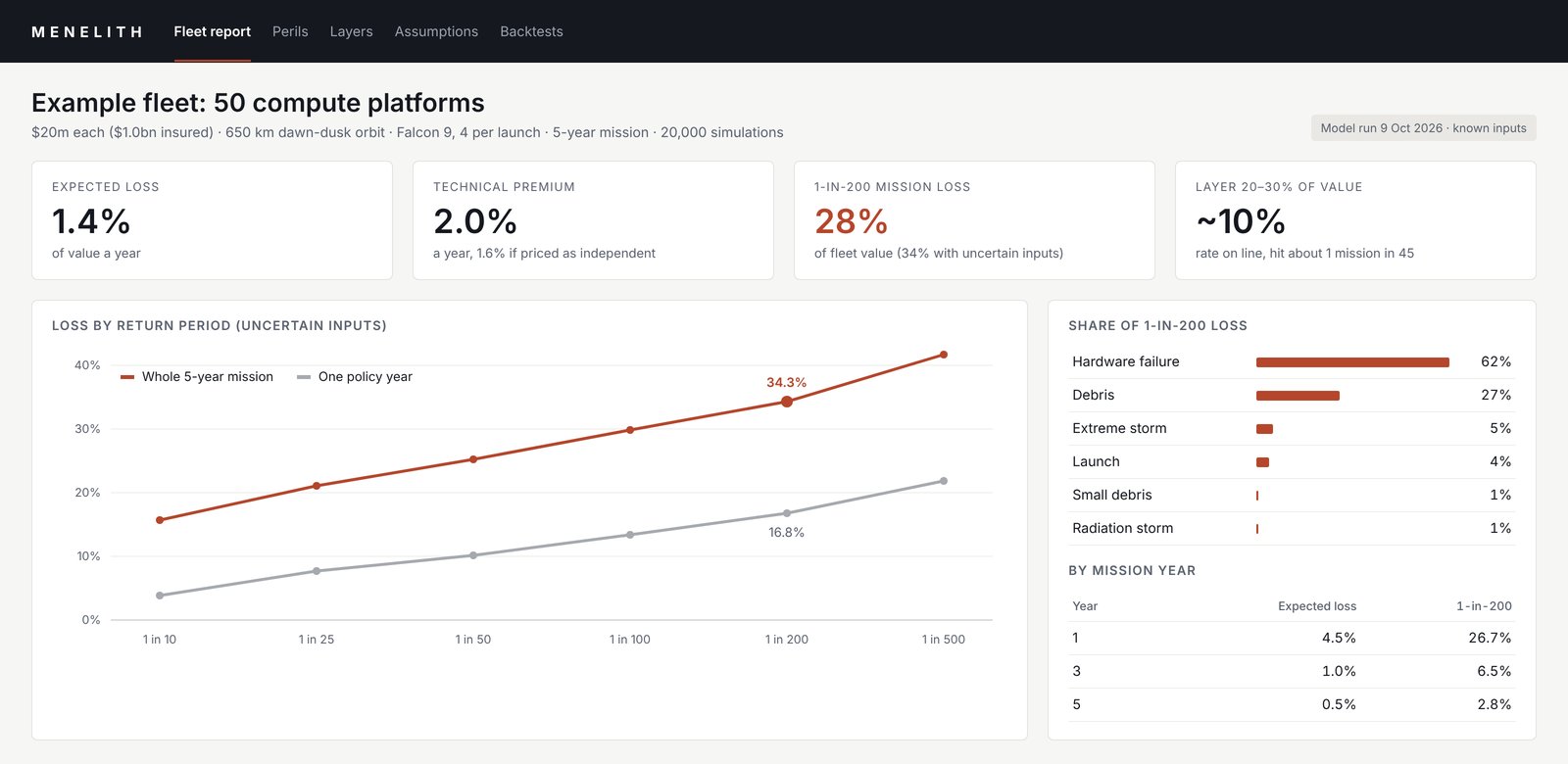
Prototype fleet report for an example fleet of 50 orbital compute platforms. Figures are illustrative.
For an example book of 1,000 satellites, our 1-in-200 loss is 2.9 times what you get by pricing each satellite on its own. That gap is the risk insurers can't see today.
A defensible view of fleet tail risk, layer by layer, to support pricing and capacity decisions.
Clear, shareable fleet reports that help bring new satellite operators to market.
Understand what drives your loss profile, and what changes would make cover cheaper.
If you insure, broker or fly satellite fleets, we'd like to hear how you price fleet risk today.
hello@menelith.com